
How to create a well balanced training programme
06 April 2023 Training

The most important thing when creating a well balanced training programme is that you choose a form of exercise that you enjoy. Sometimes this may mean that it isn’t ‘optimal’ for the fastest results possible… but it means that you are more likely to adhere to it long term, meaning that you are more likely to achieve your goals and more importantly maintain them.
Before diving into the nitty gritty of exercise selection, there are a few important factors to consider when structuring your own training programme:
Structure your training programme to suit you

-
Frequency
How often you train will depend on your goals, age and other factors. For example, if you're a beginner or have only just started working out regularly then it's best to stick with three or four sessions per week. -
Duration
How long each session lasts depends on the type of exercise being performed, but generally speaking 45 minutes is a good guideline for most people who are new to fitness training (excluding warm up and cool down). -
Progression
Progressing means changing things up every now and again so that our bodies don't get used to doing the same thing over and over again - this helps prevent plateauing which means hitting a point where progress stops happening no matter how much effort goes into training (which can be frustrating). For example if someone's goal is building muscle mass then increasing their weights would count as progression because it forces muscles into action against greater resistance than before. - Rest days
Rest days are an important part of your training schedule and should not be skipped. Rest days allow you to recover from the stress of exercise, which is essential for the body to repair itself and prepare for future workouts.
Rest days also allow you to train with more intensity, meaning that your muscles will be able to work harder in subsequent workouts because they haven't been fatigued by a previous session. By allowing yourself adequate rest between sessions, it's possible for you to increase the amount of weight lifted or number of reps completed at each session without sacrificing form or technique - something that's essential if you're looking for results! Finally, resting between workouts allows us humans (as opposed to robots) time off from our daily responsibilities so that we can focus on ourselves instead.

If you enjoy strength training and are looking to create a well balance training programme then the following should be included:
- Have a general warm up
It doesn’t matter too much what you do here, you just want to go through the gears, get the body warm, elevate your heart rate and get a sweat on. - Have a specific warm up
This can be as simple as doing a few lighter sets on your first couple of exercises to prime your body and make sure you are ready for what is about to come. - Do full body workouts
This means that you are working the full body every time you are in the gym. This keeps things simple, it means that the quality of work you do stays high and it doesn’t leave your training exposed if you miss a day. - Work across a variety of rep ranges in each session
For example some strength work at 4-6 reps all the way up to 20+ reps on some accessory movements. - Prioritise multi-joint compound movements
- Sprinkle in single-joint isolation movements
- Mix things up every now and then

Exercise selection
As a general guideline for a well balanced training programme we would suggest selecting one of each of the below movements to include in each workout.
1. Squat movement
Something more quad dominant.
This could be two legged or single leg e.g. goblet squat,
split squat, leg press, etc.
2. Hinge movement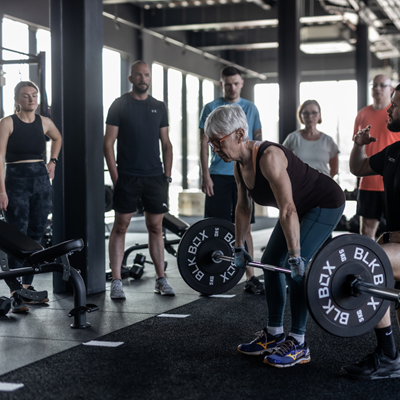
Something more hamstring/glute dominant.
Again, this could be two legged or single leg, e.g. Romanian deadlift,
single leg hip thrust, 45º back extension, etc.
3. Push movement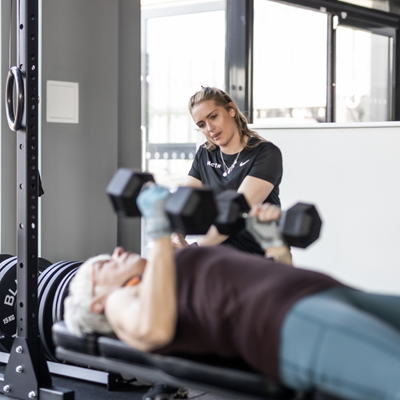
Something chest/shoulder/triceps dominant.
This can be at any angle, using any implement, e.g.
press ups, bench press, standing dumbbell shoulder press.
4. Pull movement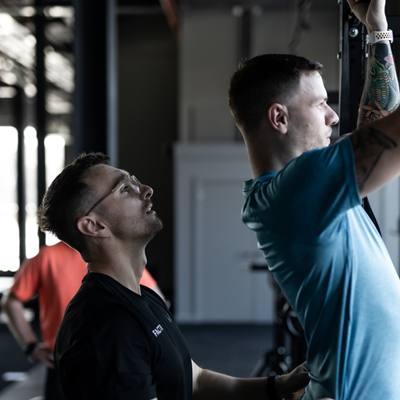
Something more back/biceps dominant.
This can be any angle, using any implement, e.g.
chin ups, bent over dumbbell row, single arm cable row.
5. Accessory movements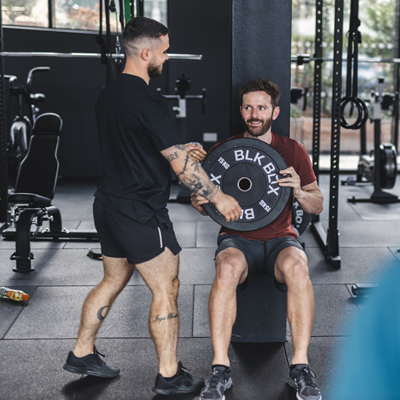
Time dependant, throw in one of each of the following
- Core e.g. butterfly sit ups, planks, etc
- Carry e.g. Farmer’s carry, single arm overhead carry
- Isolation e.g. Biceps curls, triceps pressdown,
lateral raises.. Depending on your priorities
6. Conditioning
This can be a quick circuit using the above accessory
movements, this might be intervals or this might be some
slow steady state endurance work on one piece of equipment.
Do whatever you feel like doing on the day.
Don’t worry too much about cool downs or stretching, unless you have time and you really enjoy them.
Conclusion
So there you have it, a basic guide to creating a training programme. If you follow these rules, you can pretty much guarantee that you will have a fairly balanced programme that allows for flexibility and will set you up for long term success.

